
Proprioception vs. Nociception: What Is Your Child’s Brain Listening To?
Your brain is constantly listening to your body.
Right now, without thinking about it, your nervous system has information about where your feet are, how much tension is in your muscles, whether you are sitting upright, whether something feels hot or cold, and whether any part of your body may be under threat. Most of that information never reaches your conscious awareness.
But your nervous system is paying attention to it.
This is one of the most important ideas in understanding how the brain and body work together:
The brain does not simply send instructions to the body. The body is constantly sending information back to the brain.
Two important pieces of that conversation are proprioception and nociception.
They sound complicated.
The concepts are actually pretty simple.
What Is Proprioception?
Proprioception is your nervous system’s ability to sense the position and movement of your body.
Close your eyes for a second.
Now touch your finger to your nose.
You probably did not need to look at your hand to know where it was.
That is proprioception.
Your muscles, joints, and related sensory receptors are constantly providing the central nervous system with information about:
- Where your body is positioned
- Whether a joint is bending or straightening
- How quickly you are moving
- How much force your muscles are producing
- How much resistance your body is encountering
Without this constant stream of information, even simple movement would be incredibly difficult.
Walking.
Running.
Climbing stairs.
Picking up a cup.
Writing with a pencil.
Catching a ball.
All of these require the nervous system to continuously understand where the body is and what it is doing.
Why Do Some Kids Seem to Crave Proprioceptive Input?
This is where things start getting interesting for parents.
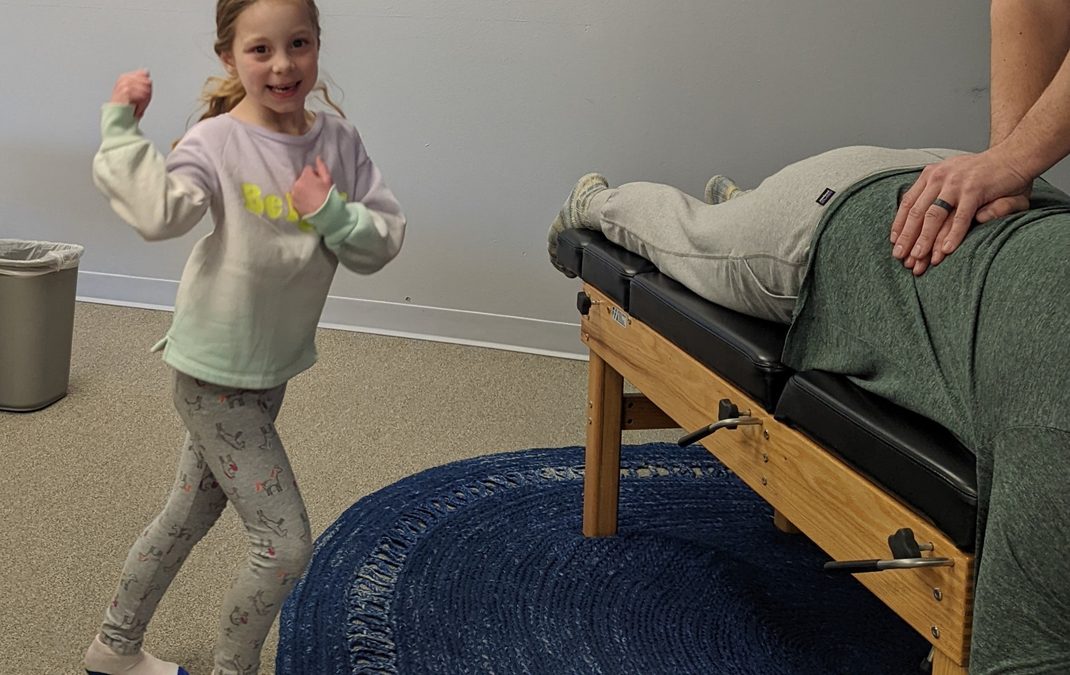
Some children seem to constantly seek movement or pressure.
They may love:
Jumping
Climbing
Wrestling
Hanging upside down
Bear hugs
Pushing heavy objects
Carrying things
Crashing into cushions
Running
Spinning
Rough-and-tumble play
There can be many reasons a child enjoys these activities, but one thing they all have in common is that they provide a lot of sensory information to the nervous system.
Activities involving resistance, muscle contraction, joint movement, and pressure can create a strong stream of proprioceptive input.
That is one reason movement can feel so organizing or satisfying for some children.
It may also help explain why asking a child who desperately wants to move to simply “sit still” can sometimes make things harder rather than easier.
We will dive much deeper into that later in this Neuro Series.
So What Is Nociception?
Nociception is different.
Nociceptors are sensory receptors that respond to potentially harmful mechanical, thermal, or chemical stimuli.
For example:
Touching something extremely hot.
Stepping on something sharp.
Experiencing excessive pressure or tissue irritation.
These receptors send information into the nervous system that helps the body recognize potential threat and respond appropriately.
That may mean quickly pulling your hand away from something hot before you have even fully processed what happened.
Nociception is one of the body’s important protective systems.
Nociception and Pain Are Not Exactly the Same Thing
This distinction is important.
People sometimes use the words nociception and pain interchangeably.
They are not the same.
Nociception refers to neural signaling related to potentially harmful stimuli.
Pain is a much more complex experience.
Pain involves the brain’s interpretation of information and can be influenced by many factors, including previous experiences, expectations, context, emotions, attention, and the state of the nervous system.
In other words:
Nociception is information. Pain is an experience.
That distinction gives us a glimpse into something much bigger.
The nervous system is not just a wire transmitting information from point A to point B.
It is constantly interpreting.
Your Nervous System Is Sorting Information All Day
Imagine everything your nervous system has to process in a single school day.
The feeling of clothing against the skin.
The sound of other kids talking.
The position of the body in a chair.
The fluorescent lights overhead.
The pressure of a pencil in the hand.
Hunger.
Movement.
Temperature.
Balance.
The sound of the bell.
Someone bumping into them in the hallway.
Instructions from a teacher.
Internal signals from the body.
And thousands of other pieces of information.
The nervous system has to receive, organize, prioritize, and respond to all of it.
Most of the time, we never even notice.
But the way the nervous system processes incoming information can have a major influence on how someone experiences their environment.
Why Movement Can Change How We Feel
Movement creates enormous amounts of sensory information.
Every time muscles contract and joints move, the nervous system gets updated information about the body.
That is one reason movement often changes how we feel.
Think about adults for a second.
How often do we:
Take a walk when stressed?
Tap our foot while concentrating?
Stretch after sitting too long?
Exercise after a difficult day?
Change positions when uncomfortable?
Movement changes the information flowing into the nervous system.
Children do the same thing – often much more obviously.
The child bouncing in their chair may not simply have “too much energy.”
The child crashing into the couch may not simply be trying to destroy your furniture.
The child who constantly wrestles with a sibling may love the strong sensory input that comes with pushing, pulling, and resistance.
That does not mean every behavior has a neurological explanation.
But it does mean behavior can sometimes give us clues about what kind of information a child’s nervous system may be seeking.
The Brain Is Listening to the Body
This is the big takeaway from this week’s article.
The nervous system is a two-way conversation.
The brain sends information to the body.
And the body continually sends information back.
Proprioception is one piece of that incoming information.
Nociception is another.
Vision, hearing, balance, touch, and signals coming from inside the body are other pieces.
All of that information helps the nervous system decide:
What is happening right now, and how should I respond?
That question is going to show up again and again throughout this Neuro Series.
Because if we want to understand regulation, behavior, movement, attention, or sensory processing, we have to understand the information the nervous system is receiving first.
🧠 Neuro Word of the Week: Proprioception
Proprioception: Sensory information that helps the nervous system understand body position, movement, and force.
Coming Next in The Neuro Series
The Gas Pedal & Brake Pedal: Sympathetic vs. Parasympathetic
Your nervous system does much more than control movement.
It is constantly changing the state of your entire body.
Next, we’ll look at how your automatic nervous system helps you activate when needed and recover when the demand is over.
Recent Comments